
Perth winters feel mild until the nights arrive. That mild reputation is exactly what leads homeowners into the first wood heater mistake: underestimating the gap between a heater that warms the room and one that strains to keep pace with an open-plan home on a July night in the Hills. The choice looks straightforward in the showroom, but the wrong size, the wrong fuel, or a misread of the compliance label creates problems from the first fire that no amount of adjustment will fix.
The Standard That Changed What a Good Heater Means
Since 2019, every wood heater sold in Australia has to meet the revised AS/NZS 4013 certification requirements. Two key figures in that standard are what really matter to someone browsing a showroom for wood heaters Perth.
Emissions have to be below 1.5 grams per kilogram of wood that’s been burnt; the lower the figure the better the combustion is going to be and the less particulate pollution you’ll be letting into the indoor air. Efficiency needs to be at least 60%, which means out of every dollar you spend on wood energy at least 60 cents is getting turned into usable heat rather than just heading up the flue. But the truth is modern high-efficiency models regularly kick out around 70 to 73% efficiency, the difference in wood usage between a bog-standard 60% unit and a top-of-the-line 72% unit is noticeable not only in the number of bags of wood you get through but the cost of running it over a Perth winter.
The Western Australian Department of Fire and Emergency Services recommends giving the heater and flue a once-over at the start of every burning season and organising a chimney sweep if you need one. Some newer Perth developments also have local council restrictions on where and how wood heaters can be installed and as you can imagine it’s a whole lot simpler to check these rules before you even buy than it is to find out after the unit arrives.
Sizing Gets Underestimated Every Time
The rated heating area on a product tag takes for granted an enclosed space that’s reasonably well insulated. Most homes in Perth, especially the open-plan designs that are so popular out on the coastal plain, just don’t fit that bill. A heater that’s rated for 150 square metres is not going to get the job done in a home like that, raked ceilings, uninsulated walls and a kitchen, lounge and dining all flowing together without any doors to keep the warmth in.
For properties up in the Perth Hills it’s a rather different situation. Overnight temperatures and sustained cold are just a lot more extreme than what the coastal plain experiences and if you buy a heater that’s suitable for a similar house down there it will be working flat out in the Hills and still struggle to keep you warm.
Freestanding vs Inbuilt: A Practical Comparison
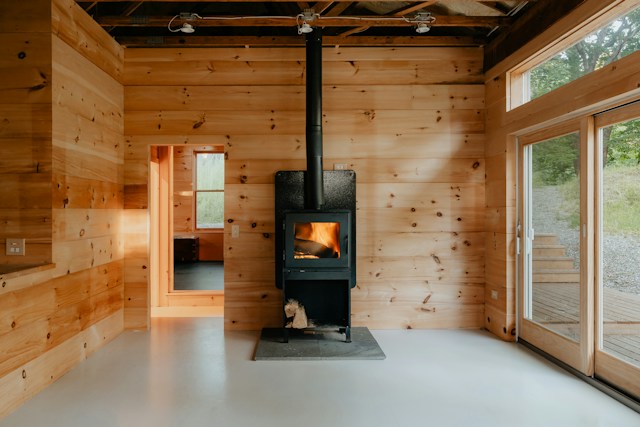
Freestanding heaters are easier and cheaper to install, do not involve any masonry works, and can be relocated. They prevail in Perth’s renovation market and are the most practical solution for rented property. Built-in fireplaces involve installation of a surround, firebox liner and sometimes some construction works; however, they create a fixed piece of interior which increases its selling value considerably. Both solutions require an appropriate flue installation to AS/NZS 2918 with regard to the flue type, its height and distance to the roof and neighbouring buildings. These requirements are non-negotiable whatever heater one chooses.
The Wood Question That Changes the Whole Calculation
Even a certified heater of an appropriate size performs badly using wet or unseasoned wood. Wet wood burns inefficiently and gives lots of smoke, deposits creosote in the flue at pace, creating a hazard of chimney fire, and creates emissions exceeding the rating of the heater several times. In other words, every time one uses wet wood in their heater, it becomes inefficient and non-compliant.
Jarrah, Marri and Sheoak are common hardwoods in the state with high energy density and longer burning time than softwood per kilogram. The wood requires at least one year of seasoning after cutting and reaches its optimal level of moisture (less than 20%) to provide efficient combustion. The climatic conditions of Perth in winter allow storing the wood outside, but one should consider using an adequately shaded, ventilated stack if purchasing wood in summer. A certified heater of the proper size with hardwood is an efficient and economically feasible way of winter heating.